
World Council for Health Law Division
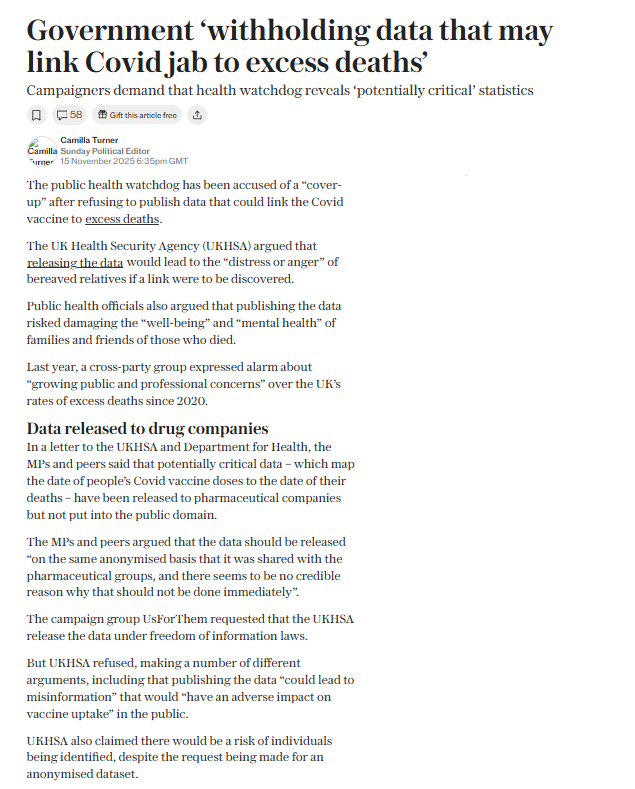
A recent UK Information Tribunal case has cast a glaring spotlight on a critical issue of public health transparency. The public has been told that the UK Government is ‘withholding data that may link Covid jab to excess deaths’, however, the UK Health Security Agency (UKHSA) has stated that releasing figures would lead to ‘distress’ of bereaved relatives if a connection were discovered.
At the heart of the case is a simple, vital question: Do the public and independent scientists have a right to access data that could illuminate the causes behind the significant and ongoing excess deaths observed in the UK and many other nations?
The evidence presented suggests that the UKHSA is actively obstructing this crucial transparency, employing a double standard that undermines public trust and scientific integrity.
The Request for Data and the “Anonymised” Obstacle
The case stems from a Freedom of Information (FOIA) request seeking data that would allow for an analysis of potential correlations between vaccination dates and mortality. In its public statements, the UKHSA claims it provided a “carefully anonymised version of the dataset that removed the risk of identification.”
This is a misleading characterisation. While a dataset was provided, it was intentionally structured to be scientifically useless. The UKHSA grouped death dates by calendar months and vaccine dosage dates by calendar weeks. This deliberate misalignment makes it statistically impossible to perform a meaningful analysis of the temporal relationship between vaccination and death—the very analysis the request was designed to enable. This is not anonymisation; it is obfuscation.
A Shifting Justification: From “Unreliable Data” to a Glaring Contradiction
When its initial obfuscation was challenged, the UKHSA pivoted to a new argument: that the data was too unreliable to release. They claimed that without specific causes of death (e.g., distinguishing a car accident from a cardiac event), any analysis would “generate spurious associations” and be “highly likely to be misleading.” This justification collapses under the weight of its own hypocrisy.
Throughout 2020 and 2021, the UKHSA and the UK government relied on nearly identical data—deaths within 28 days of a positive COVID-19 test—to justify the most consequential public health policies in a generation, including nationwide lockdowns, business closures, and mask mandates. This metric, by the UKHSA’s own new logic, would have included deaths from unrelated accidents and underlying conditions, potentially creating “spurious associations.”
Yet, this data was deemed not only reliable enough for public consumption but for enacting sweeping policies that reshaped societies and economies.
The Ultimate Double Standard: Public Scrutiny vs. Private Access
The most damning evidence of all emerged when the UKHSA admitted to a Parliamentary Select Committee that essentially the same data requested by the public had already been shared with the vaccine manufacturers for their private safety monitoring.
This reveals a disturbing two-tiered system:
For pharmaceutical corporations, the data is deemed sufficiently reliable for confidential safety analysis.
For the public, independent scientists, and the very people whose health is at stake, the same data is suddenly deemed too unreliable and too dangerous to release.
This is an indefensible position. It suggests that transparency is not the issue; control is.
Our Legal and Ethical Mandate: A Call for Robust Action
World Council for Health Law Division views this case as a cornerstone in the global fight for transparent and ethical public health. The actions of the UKHSA are not merely bureaucratic inertia; they represent a profound failure of their duty of care to the public.
We assert the following principles:
- Public Health Data Must Be Public: Data collected by public institutions, especially concerning medical interventions deployed across entire populations, must be available for independent scrutiny. This is a non-negotiable pillar of scientific integrity and informed consent.
- There Cannot Be Two Standards of Science: The same rigorous—or lax—standards applied to data used to promote an intervention must be applied to data used to assess its safety. Moving the goalposts to avoid scrutiny is a violation of public trust.
- Legal Action is a Tool for Liberation: This tribunal case is not a minor administrative dispute. It is a critical lever to pry open the doors of secrecy and hold health agencies accountable to the people they are meant to serve.
What You Can Do: Empower Yourself and the Movement
- This is not just a UK issue; it is an international pattern. We call upon citizens, scientists, and legal professionals worldwide to:
- Stay Informed: Follow the developments of this and similar legal challenges.
- Demand Transparency: File FOIA requests in your own countries for health data related to vaccine safety and excess mortality.
- Support Legal Advocacy: World Council for Health is committed to supporting and initiating legal actions that challenge censorship and demand accountability.
- Amplify the Truth: Share this information. Break through the wall of silence and let your networks know that the call for transparent science is growing louder.
The outcome of this case will set a vital precedent. It is a battle for the very soul of public health: will it be a collaborative, transparent endeavour for the people, or a closed, unaccountable system that operates behind a veil of secrecy?
World Council for Health, and our international coalition, chooses transparency. We choose accountability. We choose health freedom for all. Join us.
Volunteer with World Council for Health Law and Activism Committee
Email: [email protected]
Resources
UK Government Withholding Data That May Link to Excess Deaths
https://telegraph.co.uk/politics/2025/11/15/government-withholding-data-covid-jab-link-excess-deaths/